ENCJ Thematic Dialogue Group on the Judiciary and Media 2024/2026
Over the years, the ENCJ has undertaken several initiatives addressing judicial communication and the role of the media. The first ENCJ report on this topic was presented in 2005-2006, followed by the first set of recommendations in 2011-2012. The issue was further explored through the ENCJ’s two-year project on the Image of Justice (2017-2019), which examined public perceptions of justice and included important considerations regarding the judiciary’s interaction with the media.
The results of the Survey on the independence of judges (2022) showed that one of the stress points for judges when adjudicating cases was pressure from the media and social media. These findings were further confirmed by the ENCJ Survey on the Independence of Judges 2025, demonstrating that media pressure remains an important concern for judicial independence.
In response to these developments, ENCJ Members agreed to continue their cooperation in this field through a dedicated thematic dialogue group on “Judiciary and Media”.
Adopted on 3 June 2026 at the General Assembly in Paris, the ENCJ Report on the Judiciary and the Media provides a comprehensive response to the key objectives identified by the Working Group.
The report addresses the following key areas:
Communication strategies of Judicial Councils and courts: The report provides an overview of the communication strategies currently employed by Judicial Councils, courts, and alternative governing bodies. It highlights different institutional approaches, structures, and tools used to communicate with the public and the media.
Relations between the judiciary and the media: The report examines practices developed to establish and maintain constructive relations with the media. It identifies examples of effective communication, transparency measures, and approaches that contribute to informed media coverage of judicial work.
Media influence and judicial independence: The report analyses the challenges posed by media and social media pressure on judges and explores measures adopted by judiciaries to prevent or minimise potential risks to judicial independence.
Communication strategies for the future: The report provides guidance and reflections on the development of effective communication strategies for Judicial Councils and courts, taking into account the evolving expectations of society.
Artificial intelligence and judicial communication: The report explores the potential use of artificial intelligence in judicial communication, considering both opportunities for improving accessibility and efficiency and the need to respect ethical principles, accuracy, and public trust.
Professional development and exchange of practices: The report underlines the importance of cooperation, training, and practical exchanges among communication officers, press judges, and other judicial communication professionals to strengthen expertise and share effective solutions.
Recommendations and best practices: Based on the experiences collected from ENCJ Members and Observers, the report sets out recommendations and identifies best practices.
2011/2012 Project on Judiciary, Society and the Media
In 2011 the ENCJ set up a project which aimed to study the best practices in how the judiciary coud be better engaged with society and how the media could be used to achieve this goal. The Project Team took stock of the current practices in the judiciaries (for a full overview see the collection of replies to the questionnaire) and came up with a wide range of best practices and drafted a set of recommendations. the recommendations were adopted by the General Assembly in Dublin in 2012. The main recommendations from the ENCJ Report on Justice, Society and the Media include:
- the setting up of judicial spokespersons/press judges;
- drafting regulations for the uses ofd audio and video recording in the courts;
- having clear guidelines for use of smart phones and other communication devices;
- the development of a strategy for the use of each social media;
- the setting up of a website with information for professionals, the press and the general public and a freely accessible database of judgments;
- regulation of the relations between the Judiciary and the media through press guidelines, they should state what the media may expect of the staff of the courts and how the courts should deal with the needs of the media before, during and after court proceedings;
- the development of a proactive media approach focused on individual court cases as well as the entire judicial system.
The project team made a video introducing their project to the General Assembly: Videolink
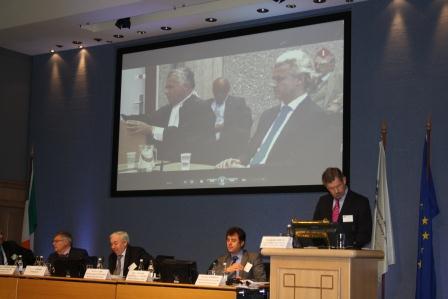
The presentation of the results of the project team by Erik van den Emster, chairman Netherlands Council for the Judiciary, at the General Assembly in Dublin, May 2012
Working group on "The Judicary and the Media"
An ENCJ working group met over the course of 2005-2006 to discuss the relations between the Judiciary and the Press. The Judiciary and the Media report, reports on the the influence of the media on public trust and on the role of the Councils for the Judiciary vis a vis the court/judges in the relations with the press .The working group concluded that the situation in every country differs and for that reason developing an European model for the organisation of the media relations is useless.
Instead of a model the working group sees many advantages in an inventory of best practices in the field of communication and press relations.

